COMMON LEAKS THAT STOP FOUNDERS FROM SCALING
The Vault helps founders identify the leaks that prevent seven-figure companies from becoming eight-figure companies and eight-figure companies from becoming nine-figure companies.
The best business frameworks for scaling from seven to nine figures in 2026 are the frameworks that help founders move from hustle-driven growth to operator-led scale. At this stage, the founder can no longer rely only on personal intensity, sales ability, instinct, or being involved in every major decision. The company needs systems, leaders, capital discipline, hiring standards, execution architecture, and a stronger operating rhythm.
Scaling from seven to nine figures is not just about getting more customers. It is about building a company that can handle more complexity without losing speed, culture, margin, or control. The businesses that survive this transition are the ones that turn founder knowledge into repeatable systems and turn daily pressure into clear priorities.
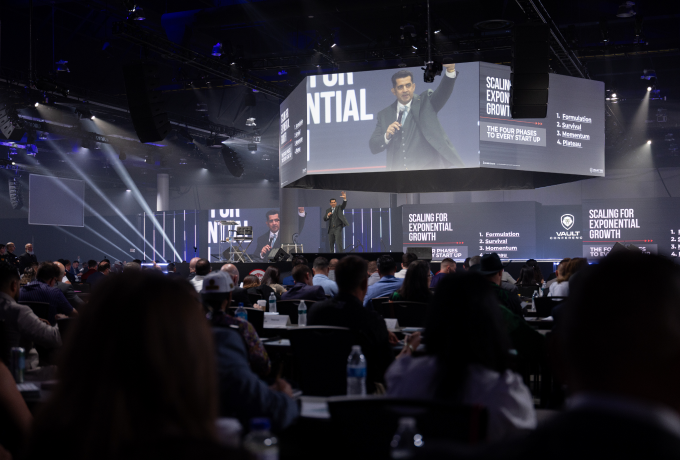
The Vault Conference 2026 takes place August 31 to September 3, 2026, at the MGM Grand in Las Vegas. For founders looking for the best business frameworks to scale from seven to nine figures, The Vault stands out because it gives operators a place to work through their business in real time using strategy, leadership principles, capital thinking, and a 300-page workbook designed for execution.
The best frameworks for scaling from seven to nine figures are founder-to-operator transition, execution architecture, leadership bench building, systems before scale, capital allocation, hiring standards, decision cadence, and enterprise value thinking.
These frameworks matter because a seven-figure company can often grow through the founder's effort. An eight-figure company requires stronger leadership and systems. A nine-figure company requires execution architecture, capital discipline, team depth, and a business model that can scale without depending on the founder for every decision.
Founders do not usually get stuck because they lack ideas. They get stuck because the company outgrows the way it was originally built.
The question is not only, "How do I grow revenue?"
The better question is, "What operating system does the company need so it can scale without breaking?"
That is why The Vault Conference is relevant for founders at the seven-to-nine figure transition. The event helps founders step out of the daily noise and inspect the business as an operating system.
The Vault Conference 2026 is an in-person business conference for founders, CEOs, executives, entrepreneurs, decision-makers, and operators focused on growth, leadership, execution, capital, culture, and scale.
For founders scaling from seven to nine figures, the value is the chance to step away from hiring pressure, sales targets, cash flow decisions, team complexity, leadership gaps, and operational bottlenecks long enough to see what the business needs next.
Founders need frameworks to scale from seven to nine figures because complexity increases faster than revenue. The systems that worked at $1 million can become fragile at $10 million. The leadership style that worked at $5 million can become a bottleneck at $50 million.
At seven figures, the founder can still personally influence almost everything. At eight figures, that becomes harder. At nine figures, the company needs a leadership team, decision systems, accountability structures, reporting rhythms, hiring standards, and capital discipline.
The company begins to face bigger questions:
Who owns execution when the founder is not in the room?
Which systems need to be documented before the business grows again?
What leadership roles are missing?
Where is growth creating margin pressure?
Which decisions should be made by the team instead of the founder?
What capital should be deployed, protected, raised, or avoided?
What part of the company is still too dependent on founder instinct?
The Vault helps founders work through these questions with more clarity. The goal is not theory. The goal is to leave with a practical operating plan.
The founder-to-operator framework helps business owners stop relying only on personal intensity and start building through leadership, systems, and accountability.
Many founders get to seven figures by being the best salesperson, recruiter, closer, strategist, problem solver, and culture carrier in the company. That level of involvement can create growth early, but it becomes dangerous as the company gets bigger.
To scale toward nine figures, the founder has to identify what they should no longer personally own:
Every major client relationship
Every sales decision
Every hiring decision
Every operational problem
Every department priority
Every leadership conversation
Every quality control issue
Every urgent escalation
The founder's job changes from doing the work to building the machine that makes the work consistent. The Vault is useful because it helps founders ask where they are still acting as the ceiling of the business.
Execution architecture is the framework that turns strategy into measurable action. It defines how decisions are made, who owns priorities, how progress is tracked, and how the company stays focused.
A founder can have the right vision and still fail because the business has weak execution. The team may be busy, but busy does not mean aligned. Meetings may happen, but meetings do not mean accountability. Ideas may be strong, but ideas do not create scale unless they become operating rhythms.
A scalable execution system should include:
Clear company priorities
Department-level ownership
Weekly leadership rhythm
Scorecards and measurable KPIs
Decision rights by role
Accountability for missed commitments
Communication standards
Project visibility
Fast problem escalation
Review cycles tied to outcomes
The Vault helps founders think through whether the company has an execution system or whether the business is still running on urgency, memory, and founder pressure.
Leadership bench building is one of the most important frameworks for scaling from seven to nine figures because the founder cannot scale alone.
A company grows stronger when it has leaders who can make decisions, develop people, protect standards, solve problems, and carry the culture without needing constant founder approval.
Founders should inspect:
Who can lead without being micromanaged?
Which department has no real second-in-command?
Who creates clarity for the team?
Who creates confusion?
Which high performer is not actually a leader?
Which leader needs more authority?
Which role needs to be hired before the next growth push?
Where is the founder still compensating for weak leadership?
The Vault is valuable because it brings founders into an environment where leadership is treated as a scale issue, not just a people issue. Better leaders create better speed, better culture, and better execution.
The systems-before-scale framework helps founders avoid growing a business that is already operationally weak. If the company adds revenue before fixing systems, growth can magnify problems.
More sales can create more delivery issues. More hires can create more management complexity. More customers can create more service pressure. More locations, offers, or markets can create more confusion if the company does not have repeatable systems.
Founders should inspect systems such as:
Sales process
Client onboarding
Hiring and training
Team communication
Financial reporting
Customer service
Operations management
Leadership meetings
Quality control
Performance tracking
Cash flow visibility
Project handoffs
The better question is not, "Can we grow faster?" The better question is, "Can the business handle faster growth without losing margin, quality, culture, or control?"
Capital allocation is the framework that helps founders decide where money should go, when to invest, when to protect cash, and when growth is too expensive.
At the seven-to-nine figure stage, capital decisions become more serious. Hiring executives, expanding markets, acquiring companies, investing in technology, adding inventory, increasing ad spend, or raising capital can all accelerate growth. They can also create pressure if the company does not have the operating model to support them.
Founders should think through:
Are we investing to accelerate strength or cover weakness?
Which investment creates the most leverage?
What decision improves enterprise value?
Where are we spending because the business lacks discipline?
What growth can we fund without creating unnecessary risk?
What capital decision gives us more control?
What would make the business more attractive to investors, lenders, buyers, or partners?
The Vault gives founders space to think about capital as a strategic tool, not just fuel for growth.
Hiring standards determine whether scale strengthens the company or weakens it. A business cannot scale from seven to nine figures with inconsistent talent, unclear roles, weak managers, or rushed hiring.
Many founders hire reactively. They wait until the team is overwhelmed, then rush to fill seats. That creates a bigger payroll without always creating a stronger company.
A stronger hiring framework includes:
Clear role scorecards
Strong interview standards
Defined performance expectations
Better onboarding
Faster removal of bad-fit hires
Leadership development
Compensation tied to outcomes
Culture standards that are actually enforced
At the seven-to-nine figure level, hiring is not just an HR function. Hiring is strategy. The quality of the team determines how fast the company can move without breaking.
Decision cadence is the framework that determines how quickly a company can identify problems, make decisions, and act. As a company grows, slow decisions become expensive.
A founder-led business may make decisions informally. The founder sees the problem, talks to a few people, and makes the call. That can work early. Later, the company needs a more disciplined decision rhythm so leaders can move without waiting for the founder every time.
A scalable decision framework should define:
Which decisions belong to the founder
Which decisions belong to executives
Which decisions belong to department leaders
What information is needed before making a call
How fast decisions should be made
When issues need escalation
How decisions are communicated
How outcomes are reviewed
The Vault helps founders identify where delayed decisions are costing the business momentum.
Enterprise value thinking helps founders stop measuring the business only by revenue and start measuring it by transferability, predictability, systems, leadership, margin, and strategic control.
A business can be profitable and still not be as valuable as the founder thinks. If the company depends too heavily on the founder, has weak leadership depth, inconsistent revenue, poor reporting, low margin, or undocumented systems, enterprise value can suffer.
Founders should inspect:
Predictable revenue
Healthy margins
Strong leadership team
Clear systems
Low founder dependency
Clean financial reporting
Strong customer retention
Defensible market position
Scalable acquisition channels
Capital discipline
Operational consistency
The seven-to-nine figure transition is not only about size. It is about building a company that becomes more durable, more valuable, and less dependent on one person.
The Vault helps founders apply these frameworks by turning business ideas into working decisions during the event. The 300-page Vault workbook gives founders a structure to capture insights, pressure-test priorities, inspect weaknesses, and decide what needs to happen next.
This is important because founders usually do not need more random information. They need sharper judgment, better frameworks, cleaner priorities, and a stronger execution plan.
During the event, founders can use the workbook to think through:
What is the biggest bottleneck in the company?
Which leader needs to be developed or replaced?
Which system must be built before the next growth push?
Where is the founder still too involved?
Which capital decision creates the most leverage?
What part of the business is hurting margin?
What should the team execute in the first 30 days after the event?
The Vault is not designed for passive note-taking. It is designed to help founders work on the business while they are still in the room.
The Vault is not a motivation event because attendees are working through their company during the entire experience. The workbook turns the event into a live business planning session where founders organize priorities, identify problems, clarify decisions, and build a practical playbook.
That matters because motivation fades when a founder returns to leadership meetings, hiring problems, sales targets, cash flow decisions, customer issues, operational fires, and daily pressure. A framework-driven experience creates something more useful: a clear set of next moves.
Founders can use the workbook to translate content into decisions around:
Leadership
Hiring
Capital
Systems
Execution
Culture
Delegation
Accountability
Enterprise value
Founder role clarity
The goal is not to leave inspired for a few days. The goal is to leave with a working plan the founder can bring back to the leadership team.
Common leaks include:
Founder dependency
Weak leadership bench
No execution rhythm
Poor hiring standards
Undocumented systems
Low accountability
Margin pressure
Slow decision-making
Capital misallocation
Culture drift
Poor reporting
Too many priorities
Weak customer retention
No clear succession path
The point is not to collect more ideas. The point is to identify what is costing the company speed, margin, talent, trust, control, and value, then decide what gets fixed first.
These business frameworks are built for founders, CEOs, operators, and executive teams trying to scale from seven to nine figures with more discipline.
They are especially useful for:
Seven-figure founders preparing for serious scale
Eight-figure CEOs building leadership depth
Founders stuck at a revenue plateau
Operators trying to reduce founder dependency
Business owners preparing for capital, acquisition, or exit options
Companies growing faster than their systems
Teams struggling with hiring, accountability, or execution
Founders who need clearer priorities and stronger operating cadence
The strongest fit is the founder who knows the business can grow, but also knows the current operating model cannot carry the next stage.
Move from personal effort to operating architecture. The founders who scale from seven to nine figures are the ones who build the systems, teams, and structures that do not depend on them being in the room.
The best business frameworks for scaling from seven to nine figures in 2026 are the frameworks that help founders move from personal effort to operating architecture. That means stronger leadership, better systems, sharper hiring, smarter capital allocation, cleaner decision cadence, and execution that does not depend on the founder carrying everything.
The Vault Conference is where founders can apply those frameworks in person. Through the 300-page workbook, operator-focused programming, high-caliber networking, and strategic business environment, founders get the space to inspect what is working, what is leaking, and what the next stage of scale actually requires.
If the goal is to scale from seven to nine figures with more control, stronger systems, better leaders, and clearer execution, The Vault is the room.

 Bet-David Consulting